cGMP-Aligned Manufacturing
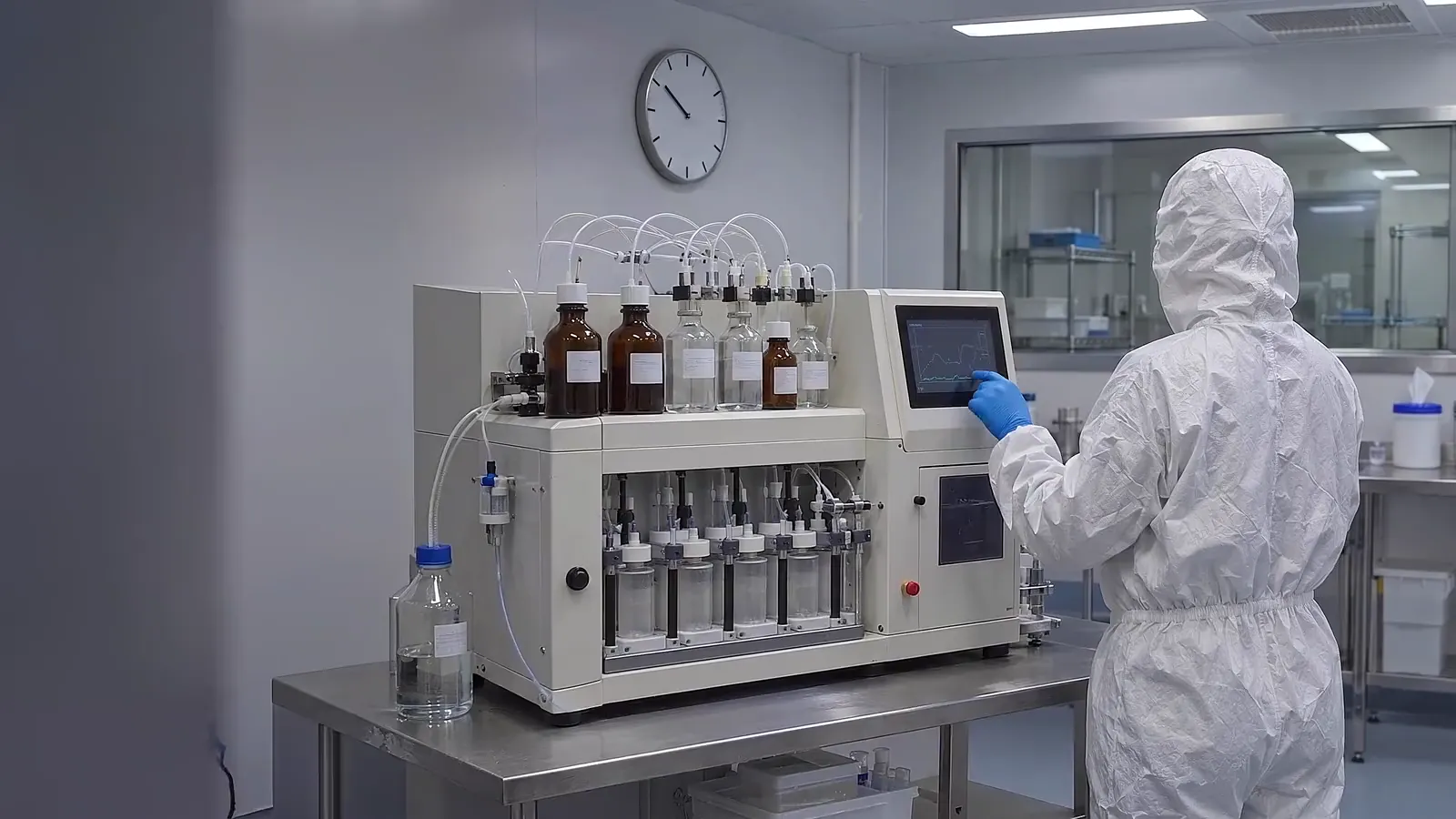
Vesalius supply chains operate under current Good Manufacturing Practice standards. Production facilities are audited, documented, and inspected on a defined cadence.
How a Vesalius product is made, tested, documented and dispensed, and what each of those steps means for the clinician who prescribes it.
From the bulk manufacturer to the participating pharmacy, each step has its own standards and its own records. Here is what happens at each one, and why it matters.
Every Vesalius product begins with a bulk substance made in the United States. Manufacturers that supply bulk drug substances must register their facilities with the FDA under section 510 of the Federal Food, Drug, and Cosmetic Act, and follow Current Good Manufacturing Practice (cGMP).
cGMP governs how a facility is built and run: trained staff, controlled and validated processes, calibrated equipment and a written batch record for every lot, so each lot can be traced back to how and where it was made.
Before a lot is released, samples are tested to confirm two things: that the substance is what the label says it is (identity), and how much of the sample is that substance rather than anything else (purity).
For peptides, identity is commonly confirmed by mass spectrometry and purity measured by high-performance liquid chromatography (HPLC). The results apply to that specific lot, which is why each lot is tested on its own.
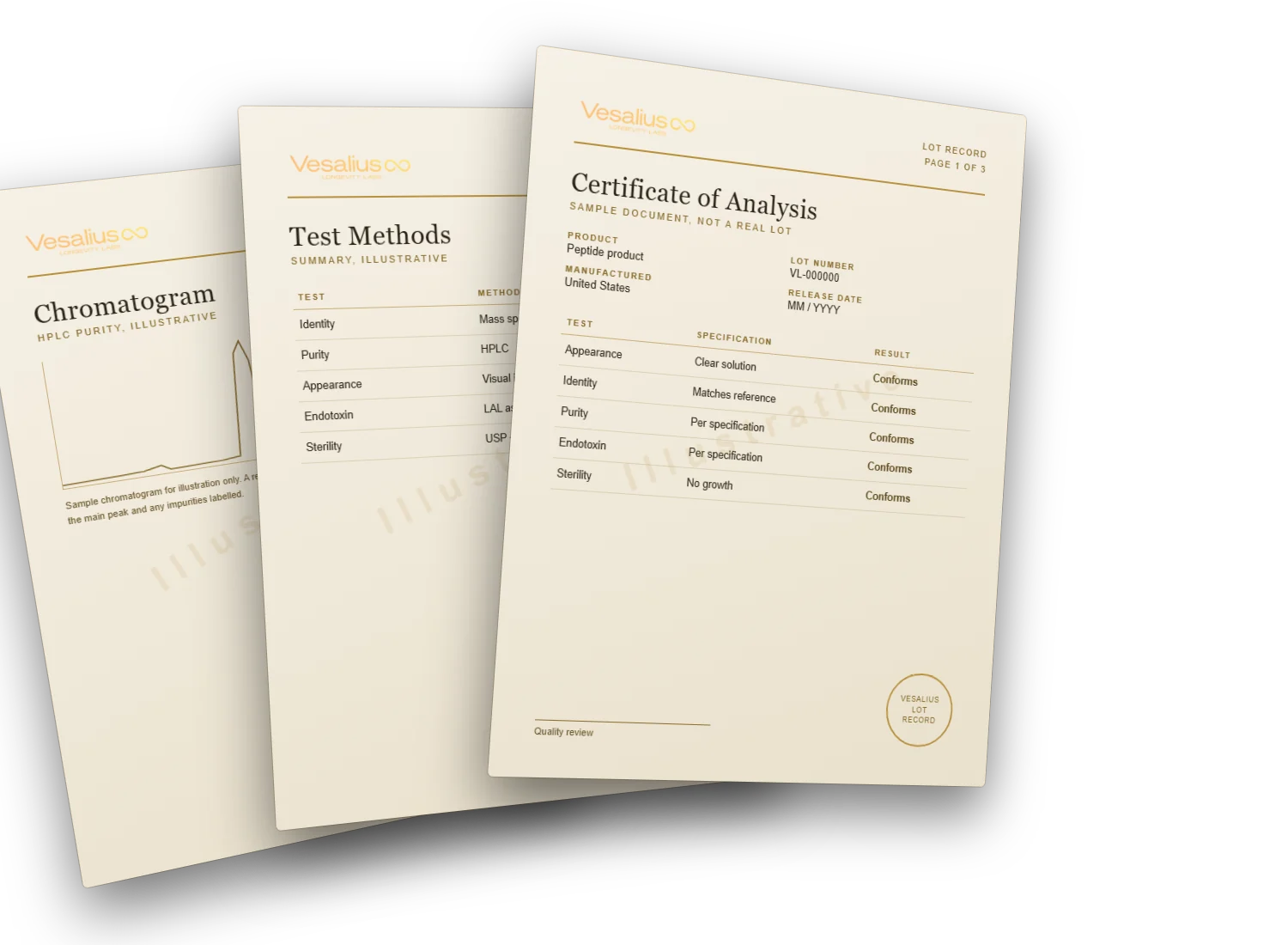
The results are recorded in a certificate of analysis tied to the lot number on the product. A certificate typically lists the product and lot, each test performed, the method used, the specification the lot had to meet and the result.
The certificate stays with the lot record, so the documentation follows the product from release to the pharmacy.*
Vesalius products reach patients only through participating 503A pharmacies, which prepare and dispense medication against a patient-specific prescription from a licensed prescriber.
Section 503A of the Federal Food, Drug, and Cosmetic Act covers traditional compounding pharmacies. They are licensed and inspected by the state boards of pharmacy where they operate, and the prescribing decision stays with the treating provider.
*A certificate of analysis documents the results of testing for a specific lot. It is not evidence of safety or clinical effect.
Every lot, every facility, every shipment is documented. We build the chain of evidence the regulators want to see, before they ask.
Vesalius supply chains operate under current Good Manufacturing Practice standards. Production facilities are audited, documented, and inspected on a defined cadence.
Every lot is documented with independent analytical testing, and the results are recorded in a certificate of analysis for that lot.
From raw material sourcing to finished dosage form, every step is logged. We do not buy from anonymous brokers, and we do not sell to anonymous resellers.
Regulatory frameworks for peptide therapeutics vary across US, Canada, EU, UAE, and Asia-Pacific. Our distribution is structured to respect each jurisdiction we operate in.
“cGMP-aligned” refers to manufacturing partners whose facilities operate under Current Good Manufacturing Practice standards. Vesalius Longevity Labs is not itself an FDA-registered manufacturing facility. All products are sourced from third-party manufacturers and verified by independent analytical testing.
Each lot is tested and its results recorded in a certificate of analysis before it ships. Lot documentation is handled inside the Vesalius provider account for participating providers, so it is not requested through this website.
The certificate pages shown are an illustrative sample, not a real lot record.
Disclaimer: The information provided on this website is intended for general educational and informational purposes only. Vesalius Longevity Labs provides information relating to peptide science, longevity, wellness, metabolic health, and emerging areas of medical research.
FDA Approval & Investigational Therapies: Not all peptides, compounds, medications, or therapies discussed or referenced on this website are approved by the U.S. Food and Drug Administration (FDA). Certain compounds may be investigational, have limited clinical evidence, or lack established long-term safety and efficacy data. References to scientific research, emerging therapies, or potential health benefits are provided for informational purposes and should not be interpreted as claims of FDA approval, established clinical effectiveness, or guaranteed therapeutic outcomes. Where legally permitted, certain medications may be compounded by appropriately licensed pharmacies in accordance with applicable federal and state laws. Compounded medications are not FDA-approved, and FDA does not review them for safety, effectiveness, or quality before marketing in the same manner as FDA-approved medications. Read the full disclaimer.